Cartographers of valleyed time, you
take in your mouths quotations, words old
men have spoken in sky-fed rivers.
Quotations break on the narrow necks
adorned with rivers, unmake the worlds
& the maps of old cartographers.
Rivers slip their fetters in the night.
You young cartographers find virgin
senses floating in old quotations.
Cartographers! To what end are you
plodding these rivers? A wearing oar
will not twice tongue the same quotation.
Rivers spew old words from their mouths. They
come again quotations on the clouds,
but heaven needs no cartographers.
Quotations crowd the skies, threatening
deluge to cartographers. Who will
dredge their images from the rivers?
Note on the Form
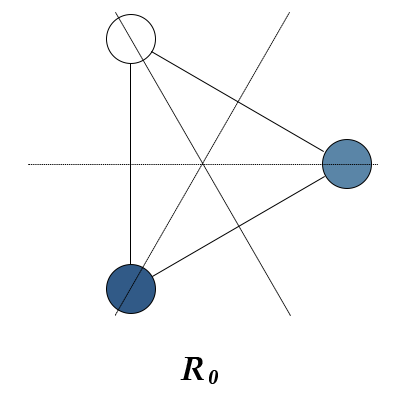
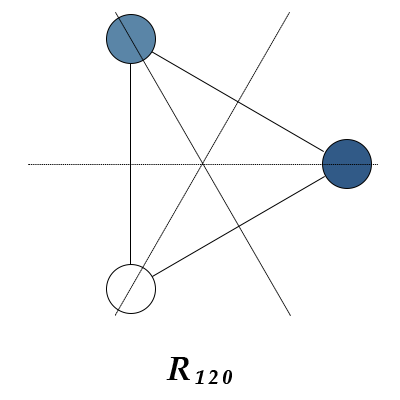
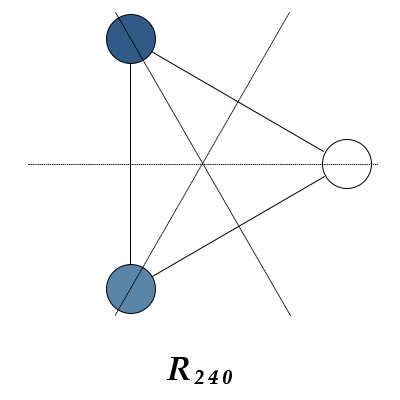
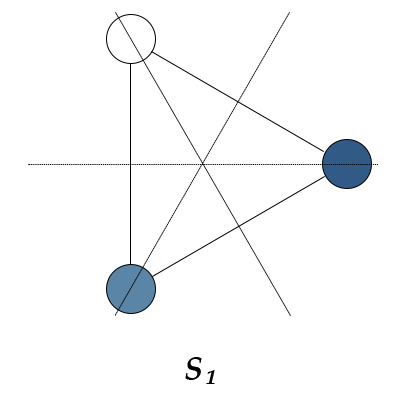
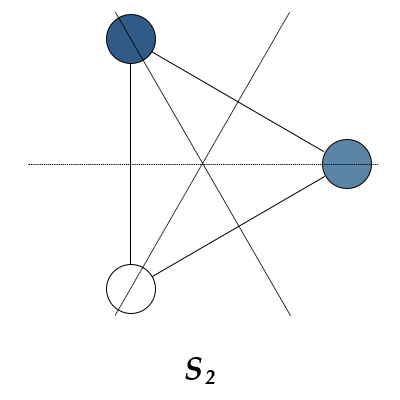
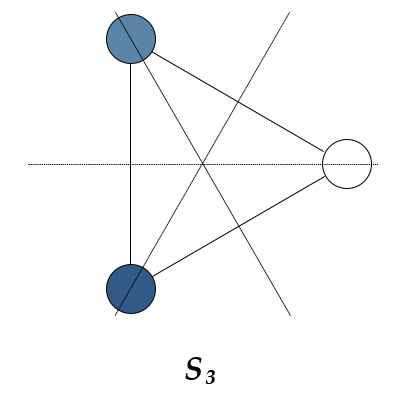
The scheme of the preceding poem is based on D3, the dihedral group of order 6. D3 can be thought of as the group of symmetries of an equilateral triangle. These symmetries are used in the poem's construction to determine the positions of certain "vertex" words within each stanza. The rules for this dihedral poem are as follows:
- Stanzas are of 3 lines, each line having 9 syllables.
-
From the first stanza, 3 vertex words are selected:
- The word which begins with syllable 1 of line 1.
- The word which contains syllable 5 of line 2.
- The word which ends with syllable 9 of line 3.
- These vertex words are considered to be equidistant "points" within the stanza, & are mapped onto the vertices of an equilateral triangle.
- The initial arrangement of vertices is taken to be the element R0 of D3. In all stanzas following the first, the positions of the vertex words are interchanged according to the remaining rotations & reflections of D3.
Another way to think of D3 is as a permutation group of the 3 vertex words. Over the 6 stanzas of the poem, the vertex words appear in each possible ordering exactly once. In this way, our dihedral form is quite similar to the sestina. In fact, had the 3 vertex words been placed at the ends of their respective lines, this form would amount to a condensed version of the sestina, sans envoi. In a few ways, I think the latter is more successful as a poetic form. Most importantly, removing the repeated words from the line-initial position allows for greater flexibility in the construction of stanzas. One could always choose articles or other auxiliary words as vertices in this new form, but one does not need a new form at all if he merely wishes to repeat "the", "be", "of" in his poems. If future variations on the dihedral poem are written, some adjustments are perhaps in order.