Some months or maybe years ago I found a paperbacked Moby Dick in the corner of an old bookstore on Main Street. It was in rough condition then—the cover torn & taped around the edges, the first page corners curled & water-stained. Yet I felt I should buy him at once. I'd never seen Moby Dick in there before, have never seen him since. I finally read my tattered copy over the course of this February past. (And here I would gush over its greatness, its power; but it is foolish for an American to say anything of Melville, who says much more of him.) In reading, my hands & prying eyes beat like a gale on plank & mast of that old ship, so that she struggled into port well-swamped with time & use. For a book, to be much read is to be destroyed, I began to think.
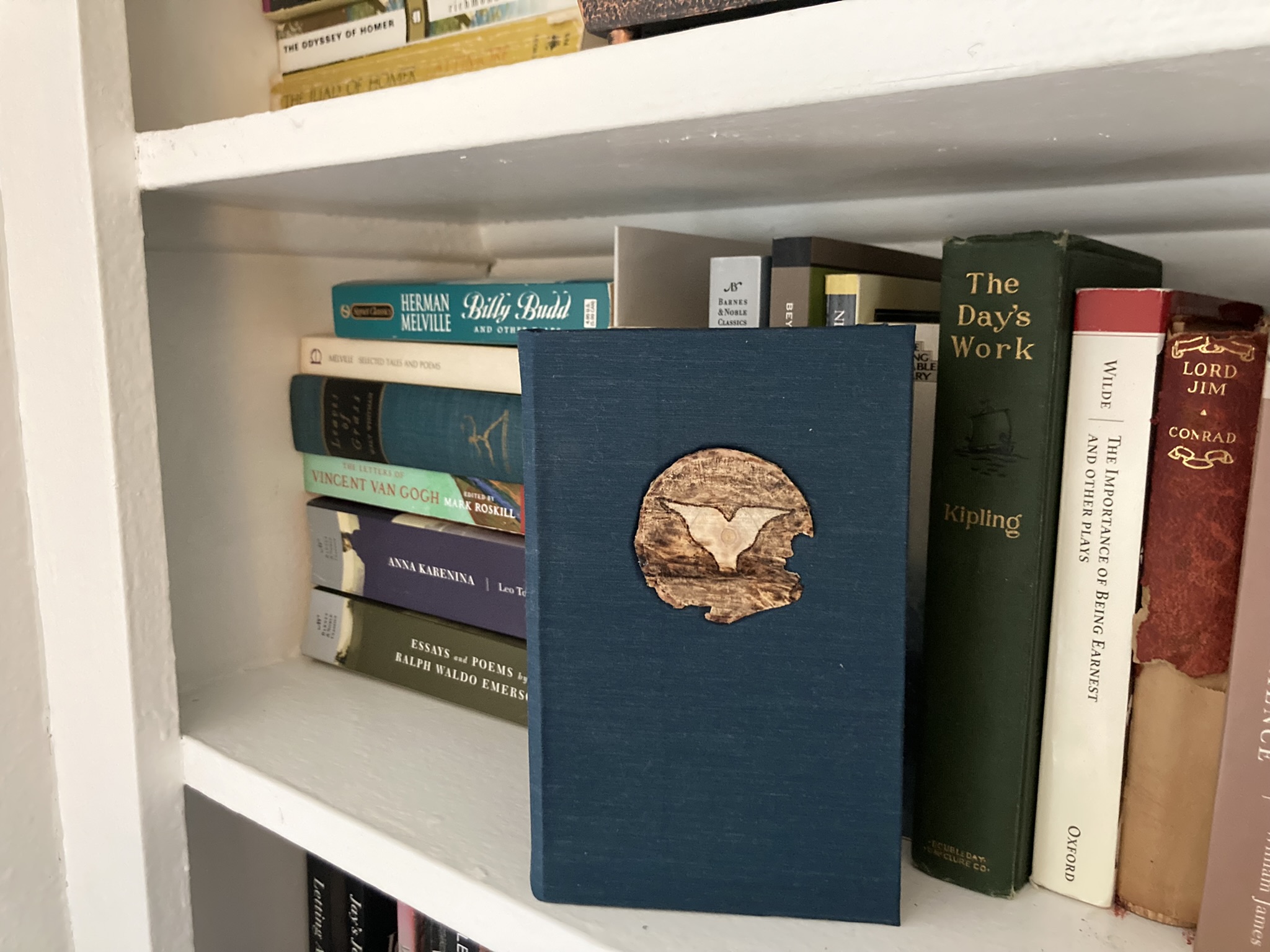
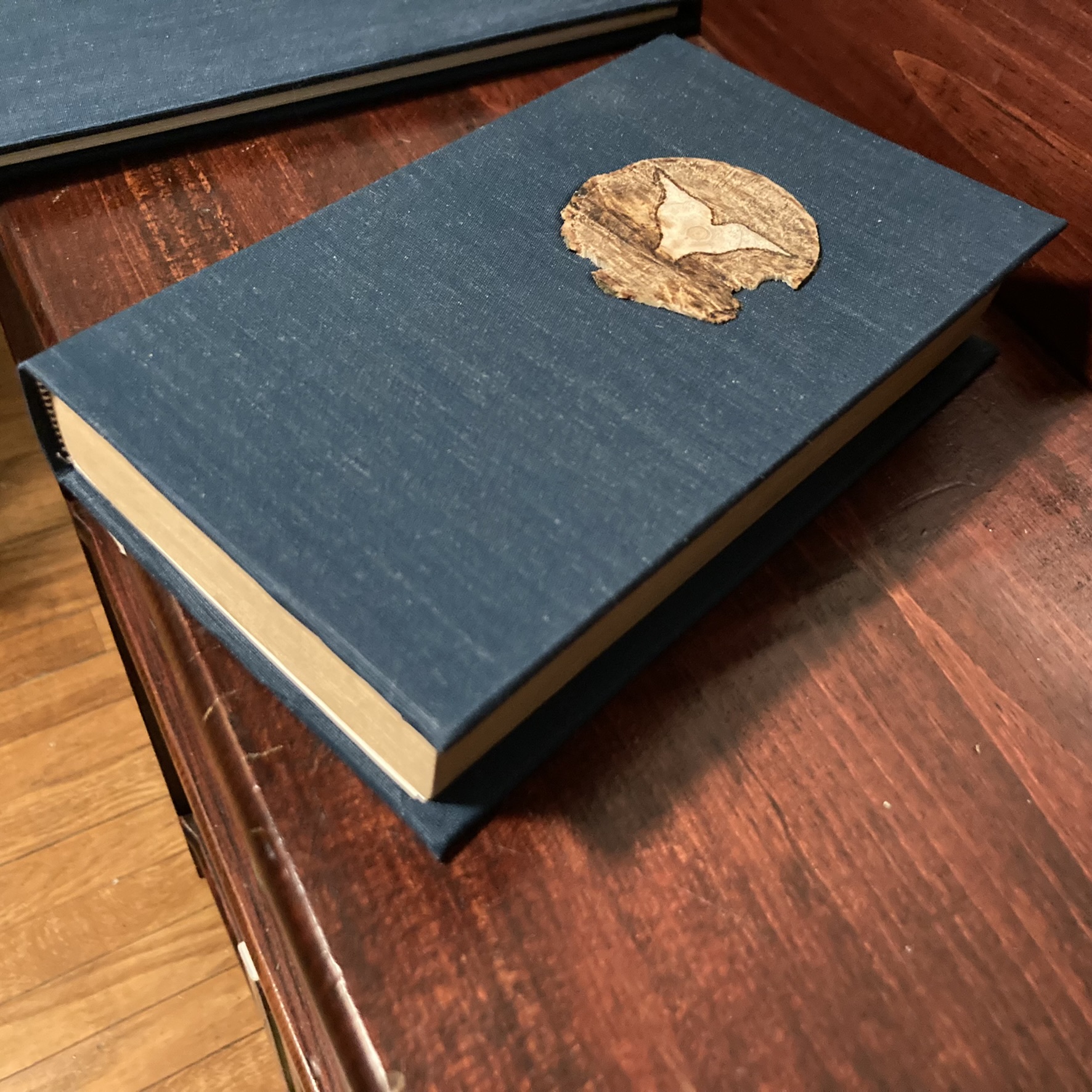
But recalling I had power to bind as well as to loose, I put melancholy aside & fetched my bookcloth. I pulled off the shredded cover; I masked the weeping corners with new endpapers; I cut greyboard to make a cradle—a coffin?—a case. I took some time deciding what would be the sign or mark of this reupholstered hull, till I lighted like Melville's seabirds on the flukes of the dread white whale. I would burn his mark on a thin disk of pine cut out from last year's tree, would set it into the greyboard with a blue & bookcloth sea to roll behind. But here Melville, & the Pequod's ghostly crew, & Jonah, & all who'd met their ends in the bowels of this cruel cetaceous globe—& even the white whale himself—began to fight me.
As I say, that disk or chip of wood was to be cut from the remnant trunk of my Christmas tree—& fitting, for the keel of Ahab's doom was cut from timbers of Nantucket, & the cross, we may suppose, was hewn from a garden among the bones of Golgotha. From the outset my woodchip was lacking in circularity; but this too was fitting, I told myself. For the earth that holds the whale in blue embrace is also somewhat oblate. Yet I cut the thing too thin, & it cracked & broke in places, so that from the oblate circumference of the woodchip earth whole nations were blotted out. I was angered, & thought to cut another from the stub of the trunk, till I reflected that this maimed & inert thing was still a fine mate for Ahab. So I burned the flukes upon it, & my fingers several times, & was happy enough to be done with it.
The time then came to cut an emblem-shaped hole in the greyboard, & so to wield another of my woodburning tools: the hot knife. The hot knife is a thin, angled blade mounted by male threads in the open female end of the woodburning pen. When the dial on the control box (which bulges rhombically from amid the power cord) is twisted from the off position, the female part of the pen is electrically warmed & transfers its energy womblike to the manly blade. Once good & hot, the temperature as well as the pressure of this appendage, being applied to diverse materials, completes a metamorphosis of their once-apparent unity. By this art you may construct dualities, or trinities, or as many hypostases as godhead & conscience require. My own task—to divide the greyboard from the greyboard, to pierce a hole in the blank, unfeatured slate—posed a philosophical more than theological problem. For by cutting a hole in the board I would make nothing out of something, & have a leftover something from nothing. And this something or nothing would be cut in one continuous coast, the navigation of whose promontories threated fractals of unfolding self-symmetry. So that something & nothing would prove to be cut of one cloth, & both infinite.
From this ambling mathematical reverie I was awakened by a burning smell. I was quick to find the source of that scorched aroma, right there where it was beneath my nose. Unaccustomed to the hot knife & ignorant of its technique, I had taken too low an angle against the greyboard. The board drank dumbly of the she-shaft's uterine warmth, till it told its usurpation by a blackened spot & cloud of acrid smoke. Alarmed, I lifted the hot knife, fortunately before the greyboard burned. By then the void for the flukes was nearly stretched, so I took the board in hand to inspect the damage. And there, on the opposite board—the one meant for the book's back cover, a pillow beneath the head of orphan Ishmael—there I felt the mark of a greater beast. This beast was not Leviathan himself (& thank God, for who can open his jaws, those doors of his face, with terrible teeth encircling?), but he must have been a phantom of that selfsame watery haunt, the dark-veiled Ocean. For that board, which was to comfort the souls long-suffering of the great American novel, was now swollen & soaked with water. Spongelike it sopped of that subtle retreating creature, who'd stowed away in some fold between the worlds, some cavern behind my leaky coffee machine.
Well, I hung those fated boards to cool & dry, & came back a later day to wrap them in burial clothes. The signs of burning & weeping had not much faded, but I was able to bind Moby Dick without further symbolical incident. The book now rests on my shelf, alongside Whitman in the pantheon. (Hawthorne is a away in another room; as in life, there is a distance between he & Melville.) Since the turning in of the cloth, the pasting of the endpapers white in their youth against the old whale's yellowed pages, there is left no outward sign of either stain. Only a chewed & oblate woodchip blazoned with the mark of the whale tells the elemental wounds that lie beneath. Yet I know that book—I know the fires & waters have been upon it.